
Certified Gottman Therapist
Licenses:
California LMFT #99008 | Texas LMFT #205614
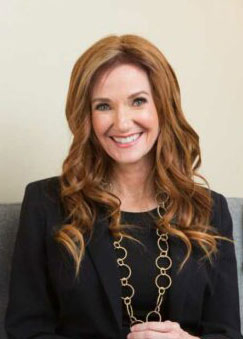
Dr. Dana McNeil is a licensed marriage and family therapist and the founder of The Relationship Place, a San Diego couples therapy practice specializing in high-acuity relationships, emotional disconnection, conflict repair, and intimacy concerns. She has achieved the highest level of training in the Gottman Method Couples Therapy and is known for her compassionate, direct, and practical approach to helping couples rebuild trust, communication, and closeness.
She is also the founder of Therapy Getaway, a structured couples intensive model designed for couples seeking deep, focused relationship repair. Dana has specialized expertise in midlife marriage challenges, empty nest transitions, and gray divorce, and provides training and professional education for therapists, including work connected to the Gottman Institute.
Her expertise has been featured in national publications including Oprah Daily, Martha Stewart Living, Men’s Health, Bustle, and SELF Magazine.
She is passionate about helping couples move from feeling like roommates to rebuilding emotional and physical connection.
- Breadcrumbing in a Relationship: Why Crumbs Never Add Up to a Cupcake - September 25, 2026
- Dr. Dana McNeil Featured in Good Housekeeping: The Real Lesson Behind “Gummy Bear Mom” Parenting - September 9, 2026
- Why the Gottman Method Works So Well for Same-Sex Couples - August 31, 2026
I recently taught a CAMFT (California Association of Marriage and Family Therapists) and Gottman Institute training for therapists on a topic that doesn’t get nearly enough airtime in couples work: collusion. Specifically, the subtle, silent, often unconscious ways therapists can drift out of neutrality without realizing it.
But the part of that conversation that’s stayed with me most has less to do with therapists, and more to do with couples themselves — because plenty of couples work against the therapy process without ever meaning to.
Not because they’re manipulative, nor because they don’t care. Usually because therapy has finally started pressing on something tender, and when people feel exposed, protection wins out over curiosity almost every time.
I see versions of this constantly. The session shifts from the relationship onto whether the therapist is “taking sides.” A conversation about a pattern collapses into a debate about facts. One or both partners get more invested in proving their point than in actually being understood by the person sitting next to them.
Emotionally, this makes complete sense. Clinically, it’s often where the work stalls.
Underneath those moments, there’s almost always fear. Fear that the therapist has already decided who the “bad” partner is. Fear of being blamed, exposed, pathologized. And maybe the quietest fear of all: that if they let themselves hope therapy might actually help, and it doesn’t, the disappointment will hurt worse than the disconnection they’re already living with.
So rather than lean into the uncertainty, couples lean back into what’s familiar. Defensiveness. Withdrawal. Keeping score. Trying to recruit the therapist as a witness. None of it is working — but familiar pain often feels safer than vulnerable change.
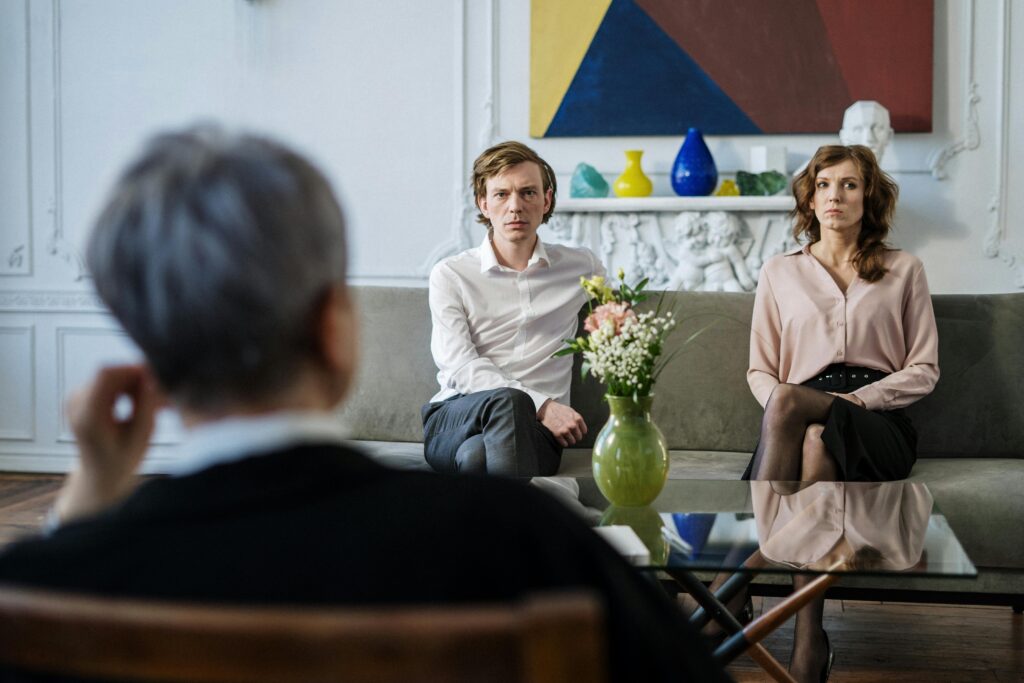
One of the biggest misconceptions about couples therapy is that the goal is to figure out who’s right. It isn’t. Good couples therapy is not a courtroom, and the therapist is not there to hand down a verdict. The work is to understand the cycle the two of you have built together, and to help both partners begin to see the relationship — not just the partner — differently.
Why this shows up so strongly in betrayal work
I see this dynamic most vividly in betrayal work.
The injured partner often arrives terrified their pain won’t be fully taken in. That the depth of it will get smoothed over, rushed past, or somehow reframed into something more palatable.
The partner who caused the harm is usually carrying fear too — it just wears different clothes. Many are afraid the therapist will only see a snapshot of them at their worst moment. They worry the years before that moment won’t be visible: the missed bids, the loneliness, the resentment, the reaches for connection that never quite landed.
And sometimes the person who caused the hurt is in genuine shock themselves — shock that they became someone capable of hurting a person they actually love. They want the therapist to see that part too, but they often arrive guarded, intellectualized, or shut down because they’ve already imagined the session ending in shame.
To be very clear: context never excuses harm. But good couples therapy also doesn’t flatten a relationship into villains and victims. The goal isn’t to erase accountability — it’s to hold accountability and complexity in the same room long enough for something to actually shift.
When neither partner trusts that complexity is possible, both unconsciously collude to keep the conversation surface-level. They argue facts instead of feelings. They debate timelines instead of loneliness. They focus on who’s right instead of what’s happened to the relationship over years.
Not because they don’t care. Because shame makes curiosity almost impossible.
Where therapy starts to get stuck
This is the point where therapy can quietly stall.
Couples become more focused on whether the therapist agrees with them than on whether anything is actually changing. Sessions turn into weekly refereeing instead of deeper understanding. One partner leaves feeling blamed every time, while the other leaves feeling protected. Or the couple abandons the process the moment real discomfort enters the room — not because therapy is failing, but because vulnerability has finally arrived.
I want to be careful here: not all discomfort in therapy is productive, and there are real moments when couples should reassess whether the therapeutic relationship feels balanced, emotionally safe, and clinically effective. If one partner consistently leaves sessions feeling dismissed or unheard, that matters. If therapy never moves past conflict management into something deeper, that matters too.
But there’s an important difference between uncomfortable and unsafe. Growth in couples therapy almost always requires both people to tolerate hearing difficult truths — about themselves, about their partner, and about the dynamic they’ve co-created. That’s hard work, especially in a culture that trains us to defend ourselves quickly rather than slow down long enough to understand impact.
What helps couples actually get something out of therapy
The couples who grow the most in this work aren’t the ones with the least conflict. They’re the ones willing to stay curious when discomfort shows up, instead of going furious.
They’re the ones who can ask, What’s happening between us right now? instead of Who’s winning this conversation?
They’re willing to tolerate not being immediately understood, and stay emotionally in the room while they wait for it. They’re willing to look at the system, not just the offense.
Because most couples aren’t actually protecting themselves from the therapist. They’re protecting themselves from shame, from disappointment, from grief, and from the terrifying possibility that change might require something different from both of them.
After years of doing this work — and now teaching other therapists about these patterns — what I keep coming back to is this: most people aren’t trying to sabotage therapy. They’re trying to survive being seen.
But healing rarely happens inside protection alone. At some point, couples have to put the scoreboard down, stop trying to recruit the therapist, and risk being honest about what’s happened to the relationship. That’s where the real work begins — not in proving who’s right, but in building enough safety, accountability, curiosity, and compassion that both people can finally understand the pattern they’ve been trapped in together.
As I often tell the couples I work with: be curious, not furious.